

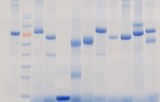
Protein electrophoresis is a gel electrophoresis technique that allows the analysis of a mixture of proteins. The gel used is composed of acrylamide, which polymerises to form a mesh network. Gel electrophoresis allows proteins to be separated for analysis and relies on the ability of charged proteins to migrate through the mesh of a gel when an electric current is applied.
The analysis of a mixture by gel electrophoresis is carried out on denatured proteins, i.e., proteins that have lost their tertiary and secondary structures. An anionic detergent covers the denatured polymer chains, giving them a charge (constant charge/amino acid ratio). Individual proteins in a complex mixture are thus coated with negative charges. When a continuous voltage is applied between the ends of a gel containing the protein mixture, the proteins migrate through the gel meshes.
Principles of Separation
- Molecular Weight: The gel mesh retains larger molecules more than smaller ones. Lower molecular weight molecules migrate faster through the gel.
- Gel Density: Separation resolution can be adjusted by using gels with different mesh densities.
- Molecular Weight Marker: Used during migration to provide a reference scale, allowing the size of each protein to be determined.
Visualization of Proteins
After migration, proteins are visualised using specific stains. The most commonly used stain is Coomassie blue, but silver staining is also possible. Molecular weight markers aid in determining the size of proteins in the mixture.