Three-dimensional (3D) cell culture has become an essential tool for generating physiologically relevant in vitro models that better reproduce native tissue architecture than conventional two-dimensional (2D) monolayer cultures. Porous polystyrene scaffolds enable cells to establish authentic cell–cell and cell–extracellular matrix interactions, resulting in improved morphology, differentiation, gene expression, extracellular matrix deposition, and tissue-specific function. These characteristics make scaffold-based 3D culture particularly valuable for cancer research, stem cell biology, tissue engineering, drug discovery, toxicology, and regenerative medicine. Peer-reviewed studies have consistently demonstrated that Alvetex® Scaffold supports the formation of reproducible tissue-like constructs while remaining compatible with standard laboratory workflows and downstream analytical techniques.
Key Features
-
Highly Porous Cross-Linked Polystyrene Scaffold : Greater than 90% porosity designed for reproducible 3D cell growth.
-
Optimized Scaffold Architecture : 200 µm scaffold thickness with interconnected pores (~36–40 µm) promoting efficient nutrient diffusion and homogeneous cell colonization.
-
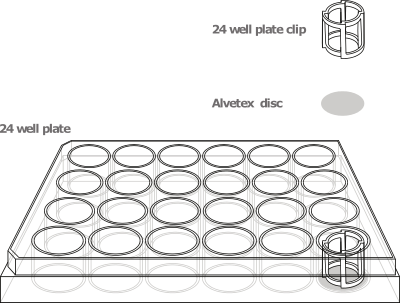
24-Well Plate Format : Optimized for short-term 3D culture experiments with routine medium replacement every 1–2 days.
-
Inert Polystyrene Composition : Minimizes experimental variability and is compatible with optional extracellular matrix coatings.
-
Comprehensive Analytical Compatibility: Supports imaging, histology, immunocytochemistry, molecular biology assays, and functional analyses using conventional laboratory protocols.
-
Sterile, Research-Ready Format : Gamma-irradiated plates supplied ready for immediate research use.