Lipids
Lipid catabolism, or lipolysis and β-oxidation, primarily breaks down triglycerides into glycerol and fatty acids, generating ATP through mitochondrial oxidation when glucose is scarce. Glycerol enters glycolysis, while fatty acids undergo activation, transport, and sequential cleavage to acetyl-CoA, yielding NADH and FADH₂ for the electron transport chain.
Triglyceride Hydrolysis
Lipid catabolism initiates with the enzymatic hydrolysis of triglycerides (TAGs) stored in adipose tissue by hormone-sensitive lipase (HSL), activated under low-insulin, high-glucagon conditions such as fasting. HSL cleaves TAGs into free fatty acids (FFAs) and glycerol, facilitated by monoglyceride lipase for complete breakdown. Perilipin proteins on lipid droplets regulate lipase access, ensuring controlled release of FFAs into circulation bound to albumin.
Fatty Acid Activation and Transport
FFAs activate in the cytosol via acyl-CoA synthetase, consuming ATP to form fatty acyl-CoA and AMP plus pyrophosphate (effectively two ATP equivalents). Long-chain acyl-CoA cannot cross the mitochondrial inner membrane directly; carnitine palmitoyltransferase I (CPT1) on the outer membrane exchanges CoA for carnitine, forming acyl-carnitine shuttled by carnitine-acylcarnitine translocase. CPT2 regenerates acyl-CoA in the matrix, with malonyl-CoA (from fatty acid synthesis) inhibiting CPT1 to prevent futile cycling.
β-Oxidation Pathway
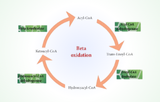
In the mitochondrial matrix, β-oxidation proceeds in four repeating steps per two-carbon unit removed:
(1) Acyl-CoA dehydrogenase oxidizes acyl-CoA to trans-Δ²-enoyl-CoA, producing FADH₂
(2) Enoyl-CoA hydratase adds water to form L-3-hydroxyacyl-CoA
(3) 3-hydroxyacyl-CoA dehydrogenase oxidizes to 3-ketoacyl-CoA, yielding NADH
(4) Thiolase cleaves with CoA to acetyl-CoA and shortened acyl-CoA.
For palmitate (C16), seven cycles yield eight acetyl-CoA, seven NADH, and seven FADH₂, netting ~106 ATP after TCA cycle and oxidative phosphorylation.
Acetyl-CoA Utilization and Ketogenesis
Acetyl-CoA enters the TCA cycle, generating additional NADH, FADH₂, and GTP for ATP production. Excess acetyl-CoA in fasting states forms ketone bodies (acetoacetate, β-hydroxybutyrate, acetone) via HMG-CoA synthase in liver mitochondria, serving as alternative fuel for brain and muscles. Peroxisomal β-oxidation handles very-long-chain fatty acids (>C20), producing H₂O₂ instead of FADH₂.
Regulation and Physiological Contexts
Lipid catabolism regulates via hormones: glucagon/epinephrine activate adenylate cyclase for cAMP-mediated HSL phosphorylation, while insulin inhibits via dephosphorylation. PPARα transcriptionally upregulates β-oxidation genes during fasting; AMPK inhibits ACC, reducing malonyl-CoA to activate CPT1. Defects like CPT1/2 deficiencies impair oxidation, leading to hypoketotic hypoglycemia.