

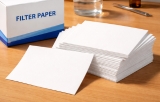
Papel de filtro sigue siendo un pilar fundamental de la filtración en laboratorio en bioquímica y biología molecular, ofreciendo una separación rentable de partículas, precipitados y biomoléculas según el tamaño de poro y la velocidad de flujo.
Tipos y Especificaciones
Los papeles de filtro cuantitativos (p. ej., Whatman Grado 1-6) presentan celulosa de algodón sin cenizas (<0,01 %) con diámetros de poro definidos (2,5-25 μm), mientras que los grados cualitativos priorizan la velocidad sobre la pureza para filtraciones rutinarias. Los papeles ultrafiltro, preparados impregnando hojas estándar con 4 % de colodión (nitrocelulosa en alcohol-éter), se endurecen con formaldehído para reducir los poros a 1-10 nm, permitiendo la separación de coloides de soluciones verdaderas mediante ultrafiltración asistida por presión. Las variantes media (10-20 μm), fina (2-8 μm) y ultrafina (<2 μm) admiten configuraciones de gravedad, vacío o embudo Büchner.
Aplicaciones Bioquímicas
En flujos de trabajo de precipitación de proteínas, el Grado 1 (11 μm) captura pellets de TCA/acetona después de la lisis, produciendo sobrenadantes limpios para SDS-PAGE. Los protocolos de ácidos nucleicos utilizan papeles sin cenizas endurecidos para el lavado de ADN plasmídico o limpieza de ARN de polisacáridos. Las variantes basadas en membrana (nitrocelulosa, 0,45 μm) clarifican lisados celulares antes del Western blot o HPLC, mientras que la ultrafiltración en la industria de la pulpa y el papel recicla agua blanca rechazando coloides (eliminación de TOC >90 %).
