

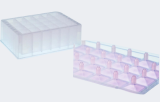
Filterplatten sind Hochdurchsatz-Werkzeuge, die die Probenvorbereitungs-Workflows in Biochemie- und Molekularbiologie-Laboren revolutionieren. Sie ermöglichen die parallele Filtration von 24, 96 oder 384 Proben, erleichtern die schnelle Isolierung von Analyten und erhöhen die Verarbeitungseffizienz sowie Reproduzierbarkeit bei Multi-Proben-Experimenten.
Design und Merkmale
Diese 24- oder 96-Well-Platten integrieren feste oder entfernbare Membranen, darunter PES, PTFE oder Glasfaser, mit Porengrößen von 0,2 μm bis 10 μm oder Molekulargewichts-Cut-Offs (MWCO) zwischen 3–100 kDa. Sie sind kompatibel mit Vakuum-Manifolds, Zentrifugationssystemen und automatisierten Plattformen. Niedrig-bindende Materialien gewährleisten Rückgewinnungsraten von über 95 %, während einheitliche Well-Tiefen (ca. 350 μL) Kreuzkontaminationen durch versiegelte Konfigurationen wie DirectStack-Designs reduzieren. Sterile Varianten sind für zellbasierte Assays verfügbar, und Anpassungen können Barcode-Integration oder spezifische Membranchemien umfassen, die auf die Anforderungen der Anwendung abgestimmt sind.
Biochemische Anwendungen
In Proteomik-Workflows unterstützen Filterplatten die Proteinpräzipitation, Entsalzung und bead-basierte Immunpräzipitation vor der Massenspektrometrie-Analyse und ermöglichen Verarbeitungsgeschwindigkeiten bis zu zehnmal schneller als herkömmliche Spin-Säulen-Methoden. In der Molekularbiologie werden sie häufig zur Plasmid-DNA-Reinigung, NGS-Bibliotheksreinigung und Entfernung von PCR-Inhibitoren mit silikabasierten Membranen eingesetzt. Die Anwendungen erstrecken sich auch auf Lipid- und Kohlenhydratanalysen, bei denen sie die Fraktionierung von Extrakten und die Konzentrierung von Metaboliten erleichtern. In zellbasierten Studien werden Filterplatten in ELISpot-Assays, Migrations- und Invasions-Assays (MIC-Platten) sowie PAMPA-Permeabilitätstests eingesetzt und unterstützen sowohl funktionelle als auch Permeabilitätsbewertungen.
