

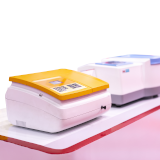
Spectrophotometers are fundamental analytical instruments widely used in biochemistry, molecular biology, and analytical chemistry. These devices enable the quantitative determination of biomolecule concentrations by measuring the absorbance of light passing through a sample solution. This measurement is based on the Beer–Lambert law, which establishes a linear relationship between absorbance and the concentration of a chemical species in solution.
Operating Principle
Spectrophotometers operate by generating polychromatic light using sources such as deuterium or tungsten lamps, typically covering a wavelength range from approximately 190 to 1100 nm. The light beam is separated into specific wavelengths using optical systems such as grating monochromators with bandwidths of about 1–5 nm or optical filters. The resulting monochromatic light passes through a sample contained in a quartz cuvette, commonly with a 1 cm optical pathlength.
Detectors such as photomultiplier tubes (PMTs) or silicon photodiodes measure the intensity of the incident light (I₀) and the transmitted light (I) after interaction with the sample. The absorbance (A) is calculated according to the Beer–Lambert equation: A = log₁₀(I₀/I) = εcl, where ε represents the molar extinction coefficient (M⁻¹·cm⁻¹), c is the concentration of the analyte (M), and l is the optical pathlength (cm). Many modern instruments use double-beam configurations, allowing simultaneous measurement of sample and reference signals for improved baseline correction and measurement stability.
Biochemical Applications
Spectrophotometry plays a critical role in numerous biochemical and molecular biology applications. For example, nucleic acid quantification commonly relies on absorbance at 260 nm, where an optical density of 1.0 corresponds approximately to 33 µg/mL for single-stranded DNA. The purity of nucleic acid preparations is frequently evaluated using absorbance ratios, such as A₂₆₀/A₂₈₀ values greater than 1.8, indicating relatively pure DNA samples.
Protein concentration can be measured using colorimetric assays such as the Bradford assay (595 nm), typically detecting protein quantities in the range of 1–10 µg, or the bicinchoninic acid (BCA) assay (562 nm), which allows quantification over broader concentration ranges of approximately 20–2000 µg. Spectrophotometric measurements are also extensively used in enzyme kinetics studies, for example by monitoring the oxidation or reduction of NADH at 340 nm during dehydrogenase reactions. In cell biology, viability assays such as the MTT assay measure metabolic activity through the reduction of tetrazolium salts detected at approximately 570 nm. Additionally, absorbance ratios such as A₂₆₀/A₂₃₀ can help identify contaminants including guanidinium salts or organic compounds carried over during nucleic acid purification.